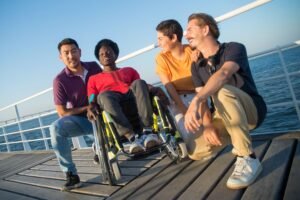
Disability day programs bring people together to learn skills, try new activities and make friends, with the support they need because of their disability. The NDIS does not use the name day programme in its list of supports. Instead, its list of supports includes group and centre based activities. This guide explains what that means, what the NDIS can fund, what you still pay, and how to choose a group that suits you.
Quick summary
- The closest NDIS support category is group and centre based activities.
- Groups can take part in community, social, cultural and recreational activities, in the community or in a centre.
- Funding usually comes from core supports, and some skill building can come from capacity building.
- You still pay the costs everyone pays, like membership, venue hire, tickets and entrance fees.
- In a group, a provider may claim from each person the maximum amount divided by the number in the group.
- If you live in supported independent living, your plan might also fund day activities separately.
What the NDIS calls disability day programs
The NDIS publishes a list of supports that are NDIS supports. It has 37 categories, and none of them uses the words day programme. The closest is group and centre based activities. The NDIS describes these as supports for participants to access and participate in community, social, cultural and recreational activities that are provided in a group setting, either in the community or in a centre.
Two related categories sit next to it. Participation in community, social and civic activities covers support to take part in community, social, cultural and civic activities. Development of daily care and life skills, meanwhile, includes building your ability to engage in social activities and improve your social skills.
In this guide, disability day programs means these supports when a provider delivers them to a group. At 1 Care Connect, our group programmes in Western Sydney are structured NDIS day activities where people build practical skills, grow their confidence and make friends.
What activities can a day programme include?
The NDIS guideline on social and recreation support lists everyday activities that people do for fun. Several suit a group setting, for example:
- learning new skills, like dance, art classes or quilting
- going places for fun, like shopping or visiting a museum
- playing sport or doing active hobbies
- relaxing, like meditation or yoga.
In addition, the NDIS says capacity building funding for increased social and community participation can help you join community and hobby groups, sport or outdoor recreation. It can also fund training to build your social skills, make new friends and build your social network.
Support can change over time, too. According to the guideline, short-term support may build your skills so you can take part on your own, while ongoing support may also be funded.
How the NDIS funds disability day programs
All NDIS funding must pass three tests. According to the NDIS page on what NDIS supports are, you can only use your funding for items that are NDIS supports, related to your disability, and in line with your plan.
Most of this funding sits in core supports. The NDIS says your assistance with social and community participation category will have funding if one of your goals is to spend more time in your local community and get involved in group or social activities and events. Its fact sheet adds that providers can deliver these supports in a range of places, such as in the community or a centre.
Capacity building can play a part as well. The NDIS says providers can deliver improved daily living skills services in groups or individually. However, the NDIS describes capacity building funding as stated, so you must use it as your plan describes.
Finally, the NDIS looks at value for money. Its guideline says that you might be able to share supports, rather than needing individual supports.
How providers charge for group support
The NDIS Pricing Schedule 2026-27 took effect on 24 September 2026. It lists support items called Group Activities, at both standard and high intensity. It also explains how group pricing works. When a provider supports more than one person at the same time, the amount it may claim from each participant is the maximum amount divided by the number of people in the group.
Some groups meet in a centre. When the main support happens in a facility, the schedule lets the provider claim an extra Centre Capital Cost amount for running and maintaining that facility. So if your group meets in a centre, check your service agreement for this item.
According to the NDIS, the maximum prices only apply to NDIA-managed and plan-managed participants. This guide does not list prices, because the NDIS sets them and they can change. You can check the current schedule on the NDIS pricing arrangements page.
What you still pay for
The NDIS may fund the support you need to take part because of your disability. You still pay the costs of an activity that everyone pays. The NDIS list of supports that are not NDIS supports includes:
- membership costs, venue hire fees, uniforms and footwear for recreational activities
- tickets to theme parks, tourism and entertainment operators
- tickets to music, theatre, cinema and sporting events, and entrance fees
- fees for outside school hours care, including vacation care and school holiday programmes.
So, before you join, ask the group what is included in its fees and what you pay on the day. Our guide to NDIS social and community participation explains the line between the activity and the support in more detail.
Day programmes alongside your other supports
Many people combine a group with other help. The NDIS guideline on supported independent living says time outside your home might include going to a group activity. It also says your plan can fund support for activities outside your home separately, for example funding for day activities or social and recreation supports.
Getting there matters too. The core transport category can pay a provider to transport you to an activity that is not itself a support, or to a support delivered by another provider. Our NDIS transport team can help with travel to programmes and activities. Some people also want one-to-one help in the community, and our community access support pairs well with group activities.
How to choose a day programme
A few questions help you compare groups:
- Which of your plan goals will the group help you work towards?
- What activities does it run, and where does it meet?
- How many people are in the group, and how many support workers?
- What will you pay yourself, such as tickets, materials or entrance fees?
- Can it support your health needs, communication and personal care?
- Can you try a session before you commit?
Frequently asked questions
Does the NDIS fund disability day programs?
It may fund the support you need to take part. The NDIS list of supports includes group and centre based activities, for community, social, cultural and recreational activities in a group. The support must relate to your disability and be in line with your plan.
Who pays for outings and activity costs?
You do. Membership costs, venue hire fees, tickets and entrance fees are on the list of supports that are not NDIS supports. Instead, the NDIS may fund the extra help you need because of your disability.
Do day programmes only run in a centre?
No. According to the NDIS, group and centre based activities happen either in the community or in a centre.
Can I go to a day programme if I live in SIL?
Yes. The NDIS guideline on supported independent living mentions going to a group activity, and says your plan can fund day activities separately to your SIL funding.
Can children use NDIS funding for school holiday programmes?
Not for the fees. Fees for outside school hours care, including vacation care and school holiday programmes, are on the list of supports that are not NDIS supports.
Is group support shared between participants?
Yes. Under the pricing schedule, a provider supporting a group divides the maximum amount by the number of people in the group. The NDIS also says you might be able to share supports as a value for money choice.
Can a day programme help me learn new skills?
It can. Development of daily care and life skills is an NDIS support category, and our guide to NDIS life skills explains how skill building works. If cooking is a goal, our guide to NDIS meal preparation and delivery covers meal help and training.
How 1 Care Connect can help
Our group programmes are NDIS day activities that build skills, confidence and real friendships. They cover life skills, social connection, recreation and hobbies, communication and confidence, and community participation, from outings to shared activities and events. A nurse-led team backs every programme, so participants with health needs can take part safely. Group/Centre Activities is also one of our approved NDIS registration groups.
Many participants combine group programmes with community access, in-home care or transport. To talk about joining a group, call 1300 264 942, email contact@1careconnect.com.au or send us an enquiry.
Related reading
- Joining in: NDIS social and community participation and what you pay for yourself.
- Building skills: NDIS life skills and how training works.
- Getting there: NDIS transport to activities and appointments.
Sources: NDIS, Supports that are NDIS supports; NDIS, Supports that are not NDIS supports; NDIS, What are NDIS supports; NDIS, What are core supports; NDIS, What are capacity building supports; NDIS fact sheet, Support categories; NDIS Our Guideline, Social and recreation support (7 April 2025); NDIS Our Guideline, Supported independent living (24 September 2026); NDIS Pricing Schedule 2026-27 and the NDIS pricing arrangements page (all read 21 October 2026). This article is general information only and is not financial, legal or clinical advice. NDIS funding, eligibility and pricing are set by the NDIS and can change. Always check the current details on the NDIS website or with your planner or support coordinator. Last updated: 21 October 2026.